Share
New sleep safety guidelines: “No co-sleeping at all”
Published 11:43 2 Jul 2022 BST
Updated 12:05 2 Jul 2022 BST
 Add us as a preferred source on Google »
Thoughts?
Personally, I opted for co-sleeping when both of my babies were babies – until they were well into toddlerhood – and often beyond that too. I did my research prior, and decided this was the best option for us – and I will be forever grateful for this experience. However, I am a really light sleeper, a non-smoker and I don't drink alcohol, so I did take all that into account before deciding this was the best thing for our family. Also – in our case – it made breastfeeding easier, it meant that I never, not once, had a night when I felt I didn't sleep enough, and I loved being able to have my babies fall asleep right next to me. However, the advice is that the safest place for babies to sleep is in their own bed, in the same room as you. Especially if you are a heavy sleeper, a smoker or have consumed alcohol. In fact, according to newly issued guidelines from the American Academy of Pediatrics, they take this advice even further and warn that co-sleeping under any circumstances is not safe for infant sleep. In the first update to its safe sleep guidelines for babies since 2016, the AAP says some 3,500 infants die from sleep-related infant deaths in the United States each year."Co-sleeping significantly raises the risk of a baby's injury or death"
"We know that many parents choose to share a bed with a child, for instance, perhaps to help with breastfeeding or because of a cultural preference or a belief that it is safe," said Dr. Rebecca Carlin, who co-authored the guidelines and technical report from the AAP Task Force on Sudden Infant Death Syndrome and the AAP Committee on Fetus and Newborn, in a statement issued last week.
"The evidence is clear that (co-sleeping) significantly raises the risk of a baby's injury or death," said Carlin, who is an assistant professor of paediatrics at Columbia University Irving Medical Center.
"For that reason, AAP cannot support bed-sharing under any circumstances."
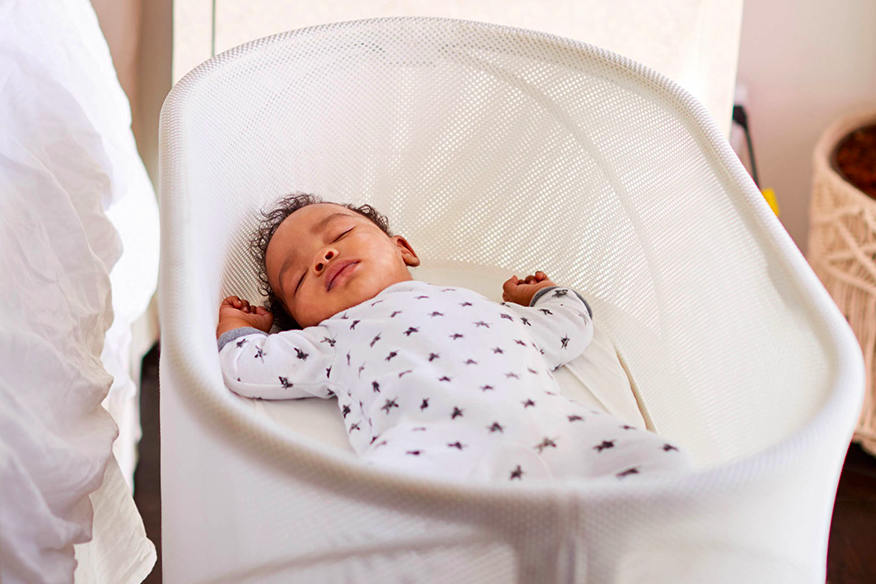
Avoiding sharing a bed with your infant is just one of a number of recommendations the AAP provided to paediatricians to help stem the tide of infant sleep deaths.
"We've made great strides in learning what keeps infants safe during sleep but much work still needs to be done," Dr. Rachel Moon, lead author of the guidelines and professor of paediatrics at the University of Virginia, said in a statement regarding the updated guidelines.
Same room, separate bed
While the AAP strongly advises against co-sleeping, its updated guidelines say babies should sleep in the same room with their parents for at least six months on a separate sleep surface with a firm, flat surface.
Based on new Consumer Product Safety Commission regulations that will go into effect in the US this week, the only products which can be marketed for infant sleep include cribs, bassinets, play yards and bedside sleepers. Bedside sleepers are separate small cribs or bassinets that attach to the parent's bed but allow babies to sleep alone without any bedding.
Parents should not use products for sleep that aren't specifically marketed for sleep, the AAP said.
Other sleep environments can also put infants at risk. Resting with a baby on a couch, armchair or cushion and falling asleep raises the risk of infant death by 67 percent, the AAP noted. If the baby is pre-term, born with low birth weight or is under four months old, the risk of death while co-sleeping on a bed, couch or other spot increases five to 10 times, the academy said.
On their backs on a flat, firm mattress
According to the new guidelines, babies should be put to bed alone, on their backs and on a flat, firm mattress covered in a snug, fitted sheet.
Importantly, you should avoid all extras in the crib, including soft toys, blankets, pillows, soft bedding, sleep positioners or crib bumpers, as babies can become trapped by such items and suffocate.
Since crib slats are now regulated to be close together, bumpers are no longer needed, the AAP said.
"Stores now sell mesh bumpers and vertical crib liners. But even these can get loose and become a strangulation risk. Babies can also get trapped between them and the crib mattress," the academy warned.
Less than a 10% incline allowed
All products marketed for infant sleep that have more than a 10 percent incline will also be banned going forward. This includes inclined sleepers and sleep positioners -- which are also called baby nests, docks, pods, loungers, rockers, and nappers.
Many such products on the market have up to a 30 percent incline, which can be dangerous because babies' heads fall forward during sleep, and this chin-to-chest position can restrict their airway, causing suffocation.
Car seats, strollers, swings, infant carriers and infant slings can also obstruct a baby's airways, the AAP said. So when your baby falls asleep in them -- which is inevitable -- parents should move the child to lie on their back on a flat, firm surface.
Explore more on these topics: